This November’s midterm elections will determine which parties control the U.S. House of Representatives and the Senate in 2027 and 2028. While each of us brings our own political views to the ballot box, ESOP advocacy operates on a different, and essential, principle: advancing employee ownership by supporting leaders who have demonstrated a strong commitment to ESOPs, regardless of party.
That distinction matters. Congressional majorities shift, often rapidly, particularly in today’s polarized environment. But the mission of The ESOP Association remains constant—to advocate for policies that strengthen ESOPs and protect employee owners, no matter which party holds power.
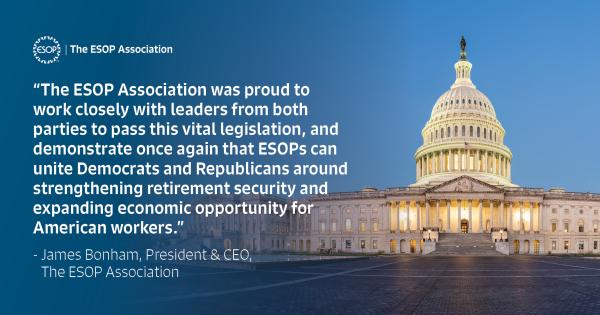
Through sustained engagement, and with strong participation from employee owners during our annual ESOP Advocacy Day on Capitol Hill, the Association has helped bridge political divides. Over many years, we have built productive working relationships with lawmakers on both sides of the aisle. And we’ve also worked to build and strengthen relationships between our members and elected officials. As a result, employee ownership stands out as one of the few issues in Washington that enjoys broad bipartisan and bicameral support.
Our approach is producing results. Working closely with members of the Senate Appropriations Committee, we secured $2 million in funding for the Employee Ownership Initiative at the U.S. Department of Labor, signed into law earlier this year. These funds will support state-level efforts to expand awareness of employee ownership and provide technical assistance to businesses transitioning to ESOPs. At the same time, the Retire Through Ownership Act is close to becoming law, which would bring much-needed clarity to initial ESOP transaction valuations, benefiting trustees, valuation firms, and employee owners alike.
These advances would not be possible without ESOP champions in Congress, particularly those serving in leadership roles on key committees such as Senate Health, Education, Labor & Pensions, the Senate Finance Committee, and the House Education & Workforce Committee. Several of these leaders face competitive reelection campaigns this year. Supporting them is not political posturing, it is a practical necessity to ensure continued progress on pro-ESOP policy.
That is the role of ESOP PAC, the Association’s political action committee. ESOP PAC exists to provide support to the reelection campaigns of lawmakers who are advancing ESOP legislation, convening hearings, speaking publicly about employee ownership, engaging with federal regulators and building relationships with the Association and our members Notably, TEA is the only group advocating for all ESOPs that maintains a political action committee.
Individual employee owners fund ESOP PAC because they understand what’s at stake—the long term strength of their companies and the retirement security tied to them. Collectively, these contributions allow the ESOP community to speak with a unified voice in support of effective leadership in Congress.
Equally important, ESOP PAC operates intentionally as a bipartisan organization. To help ensure employee ownership never becomes a partisan issue, the PAC contributes nearly equally to Democrats and Republicans in both chambers. We make all contributions fully transparent and publicly disclose them. For example, during the 2024 election cycle, ESOP PAC supported Senator Ron Wyden (D-Oregon), Ranking Member of the Senate Finance Committee, and Representative Jason Smith (R-Missouri), Chair of the House Ways & Means Committee, leaders on two committees that shape federal tax policy. These decisions hinge on one standard—whether a candidate’s legislative record shows strong support for employee owners, their ESOPs, and the integrity of ESOP companies and plans.
As we closely track the 2026 House and Senate campaigns, we will continue to allocate ESOP PAC resources where they can have the greatest impact for employee ownership. To learn more about how you or your ESOP can participate in this effort, please contact Greg Facchiano at gfacchiano@esopassociation.org.