The House Education and Workforce Committee today held a markup to debate and pass the ERISA Litigation Reform Act (HR 6084), a bill that would protect employee retirement savings from predatory lawsuits targeting ERISA-regulated plans, including ESOPs. The ESOP Association (TEA) has endorsed HR 6084 and supported its passage. The committee approved the bill by a vote of 19 to 13. The next step for the legislation would be consideration by the full House of Representatives.
HR 6084 contains three important provisions that address core issues with current pleading standards. ESOPs and service providers are currently required to prove their innocence to defend against any allegation of impropriety, rather than a plaintiff who is making an allegation proving an ESOP’s or service provider’s guilt. The bill’s main provisions would:
- Change the burden of proof for adequate consideration, meaning that instead of an accused ESOP proving it paid fairly for the business, the burden of proof will now fall on the plaintiffs to prove their allegation that the price was unfair.
- Change the current burden of proof to require plaintiffs to prove that service provider fees were not reasonable and not necessary.
- Ensure that the expensive and time-consuming process of discovery does not occur until a court has decided a claim may move forward.
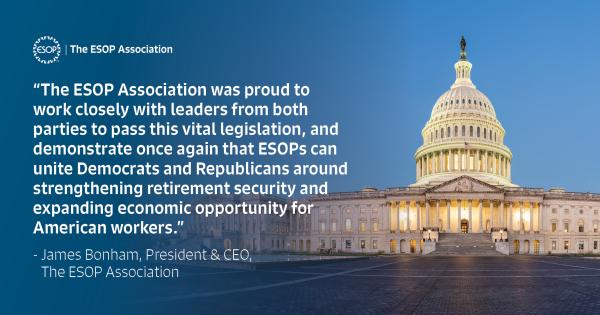
“Commonsense litigation reform, like the kind proposed in HR 6084, helps restore much-needed balance to our legal system,” said James Bonham, President and CEO of The ESOP Association. “Existing laws incentivize the plaintiff’s bar to bring expensive, nuisance lawsuits that cost ESOPs time and money without providing meaningful value to employee owners. In stark contrast to the “innocent until proven guilty” principle, ESOP companies are instead forced to defend their conduct in court at great expense for any allegation. Our membership owes a debt of gratitude to Chairman Walberg, Representative Fine, and all members of the House Education and Workforce Committee who supported this vital legislation.”
Committee Chairman Tim Walberg, in his opening statement for the hearing, said, “Over the last 10 years, frivolous class action lawsuits against employer-sponsored benefit plans governed by ERISA have grown, draining time and resources. These lawsuits make it harder and more expensive for employers to provide voluntary benefits, ultimately harming the workers and retirees ERISA was meant to protect.” The Chairman continued, “Workers, employers, and retirees all lose out as legal fees soar as plan resources are drained. ERISA was designed to protect retirement savings—not to bankroll a business model of opportunistic lawsuits.”
Representative Randy Fine (FL), who introduced HR 6084, speaking about how his bill addresses lawsuits involving ESOPs: “Today a lawsuit can often proceed by simply alleging that an ESOP purchased employer stock, again shifting the burden to the fiduciaries to prove that the price was fair. My bill simply restores balance. A lawsuit must plausibly allege and ultimately prove that the plan paid more than fair value for the stock. This ensures legitimate cases can proceed while the frivolous ones are dismissed early. And it ensures plaintiffs can back up their claims.”
TEA’s Bonham testified at the House Education and Workforce Committee in July 2025 about the need for greater transparency and litigation reform. During that hearing, Congressman Randy Fine of Florida questioned Bonham about the Bowers+Kubota ESOP case. Rep. Fine introduced HR 6084 shortly thereafter, and the House Education and Workforce Committee held a hearing on this issue in December 2025.