The U.S. Department of Labor (DOL) recently released its Employee Ownership Initiative Report to Congress. The bipartisan Worker Ownership, Readiness, and Knowledge (WORK) Act, enacted as part of the SECURE 2.0 Act in 2022, directed the DOL to report on its activities to promote employee ownership. Senators Jerry Moran (R-KS) and Bernie Sanders (I-VT) sponsored and advanced the legislation, which was supported by many TEA congressional champions. The WORK Act also created the Employee Ownership Initiative at the DOL and mandated a formal rulemaking process on adequate consideration. The full report can be found here.
TEA’s membership strongly supported the WORK Act, and the DOL’s response to the law’s bipartisan directives is encouraging. Since its passage, key senior DOL officials, and especially the DOL’s Director of Employee Ownership (DEO), have engaged on ESOPs and employee ownership. These actions, along with other vital decisions like ending the National Enforcement Project against ESOPs, constitute a major shift from the DOL’s prior adversarial posture.
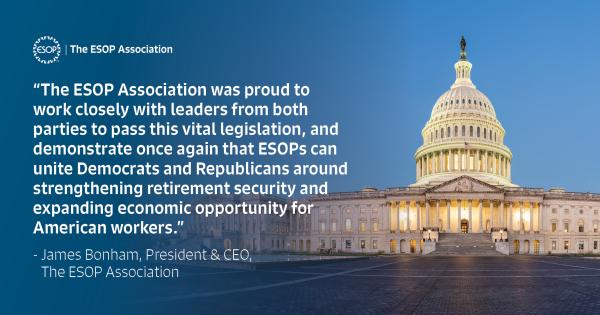
“ESOPs and employee ownership provide a public good by increasing retirement security for employee owners, creating good high-paying jobs for American workers, and greater economic stability for communities,” said James Bonham, President and CEO of The ESOP Association. “ESOPs have long enjoyed strong bipartisan support in Congress, yet for decades were subjected to overzealous regulation at the DOL. The passage and implementation of the WORK Act, together with new leadership at the DOL, has helped to rebuild trust between ESOPs and their chief regulator. This is exactly the sort of shift we hoped for when we worked with our Congressional Champions to pass the WORK Act.”
ESOP Highlights:
The report includes several data points that highlight the strong growth of ESOPs and the retirement potential for employee owners, including:
- The number of total ESOP participants grew by 8% from 14.0 million in 2014 to 15.1 million in 2023.
- The total assets in ESOP plans have grown at a notably faster pace than the number of plans and participants, increasing by 57% over this ten-year period.
- Average assets per plan grew from $197 million in 2014 to $314 million in 2023.
- Over the last ten years, leveraged stand-alone ESOPs experienced the largest growth in plans, participants, and assets. From 2014 to 2023, plans of this type increased by 28%, while their total participants grew by nearly 40% and total assets by 184%. This type of ESOP paid $6.2 billion in direct benefits in 2023, nearly tripling from 2014.
Policy Highlights:
Notably, the DOL report discusses state government employee ownership initiatives, making important distinctions between state government employee ownership programs, which the DOL terms “SEOPs,” and other efforts to promote employee ownership in states. The report also references several state policies that incentivize ESOPs, many of which TEA has supported, endorsed, and helped pass into law.
The report also acknowledges private equity’s employee ownership efforts are “different from ESOPs”, aligning with The ESOP Association’s views on this issue.
The January report, drafted before Congress passed the Consolidated Appropriations Act, 2026, cites the potential for federal grants to expand state employee ownership programs if Congress appropriates the funds. TEA strongly supported the $2 million allocated for the grant program, which became law February 3, 2026.